○Introduction
My name is Hiroyuki Saratani and I am currently working in Paris, France, as a Shumei Natural Agriculture extension worker. I am mainly active in France, but my activities in Madagascar , a large island nation in Africa, started when I met a person from there during my activities in France. In this issue, we introduce the development of Natural Agriculture activities in Madagascar.
Development of Natural Agriculture in Madagascar
○Background
With a total land area of 592,800 Square kilometers, Madagascar is the 46th largest country in the world. It is an island country located in the Indian Ocean, southeast of the African continent. The capital is Antananarivo, with a population of approximately 30 million, and about 80% of the working population engaged in agriculture. Rice is the staple food, and spices, coffee and cocoa are also produced and exported. Additionally, Madagascar is the world’s largest producer of vanilla.
Madagascar’s climate typically has a wet season (from December to April) and a dry season (from May to November). The nation is classified as one of the poorest countries in the world, with about 80% of the population living on less than $2 USD per day. The official language is Malagasy, and French is widely spoken as well. 85% of the population practices Christianity.
○Children’s education and food environment
Approximately one in three adults in Madagascar cannot read or write. With 80% of the population living below the poverty line, it is very difficult for families to focus on education with many children as young as five years old having to start helping at the home. Even those who are able to attend school lack literacy skills, with 96% of pupils between the ages of 6 and 10 unable to read simple texts by the time they leave primary school. Madagascar has also experienced extremely low rainfall over the past few years, especially in the south, where rivers are drying up, the land is becoming thinner, and crops cannot grow. As a result, more than one million inhabitants suffer severe water and food shortages, and more than 110,000 children are said to be severely and acutely malnourished.
[Adapted from ‘Madagascar – Food and medical care for children’, World Medical Corps]. (In Japanese)
○Beginnings of our activities
Our Natural Agriculture activities in Madagascar first started when Noromashiya Gerber, a Malagasy living in Paris, met me in 2011 and learned about Natural Agriculture. Later, in 2012, I met her sister Yanna, who was impressed with Shumei Natural Agriculture’s philosophy and overriding respect and concern for nature. The following year, in 2013, Janna founded and became the president of AgriNature , an association that aims to promote Natural Agriculture.
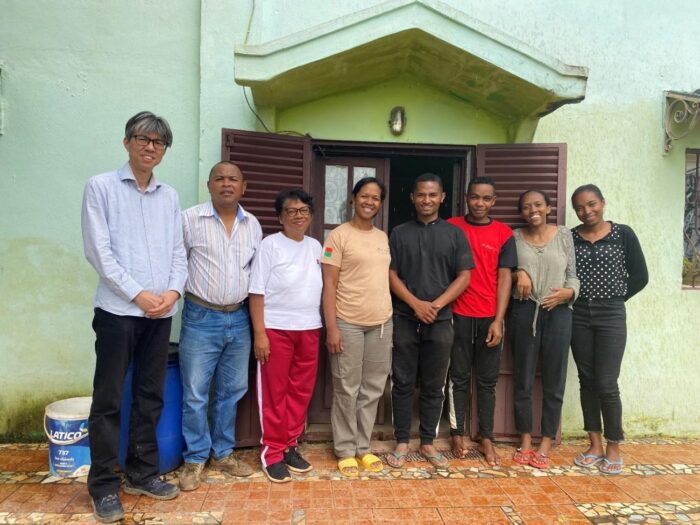
↑Saratani (far left) with Yanna (third from left) and other staff of the association ‘Soakilonga’
○Necessity of Natural Agriculture
The general farming situation in Madagascar relies on pesticides and chemical fertilizers which are expensive and unaffordable for most farmers. Although those farmers are commonly using cow dung as a fertilizer, it too is expensive and the transportation is time-consuming. From a cost perspective, the Shumei Natural Agriculture practice is attractive to farmers; instead of having to buy new seeds, they are collecting them from their own yields. Some farmers who initially started out because they were interested in the cost savings of Natural Agriculture are now aware of the higher quality and flavor of the crops and are continuing the practice. However, others have given up on the practice because of poverty challenges and the desire for faster growth and the money from sales.
○Current activities
At the start, workshops were given to rural village farmers from the outskirts of Antananarivo who would then start the practice and sell their products. Currently, extension activities are focused on schools, orphanages and other institutions where children gather.
Two typical examples are given below.
Association ‘SOAKILONGA’:
Working primarily to improve the food environment for mothers and children.
SOAKILONGA has been working with Natural Agriculture since 2022, and the plots are managed by its staff. The representative, Josette RAKOTOHERY, who works as a medical doctor specializing in nutrition came across SOAKILONGA through her connection with Janna. The facility provides adequate nutrition with Natural Agriculture vegetables inside the school lunches given to about 40 children.
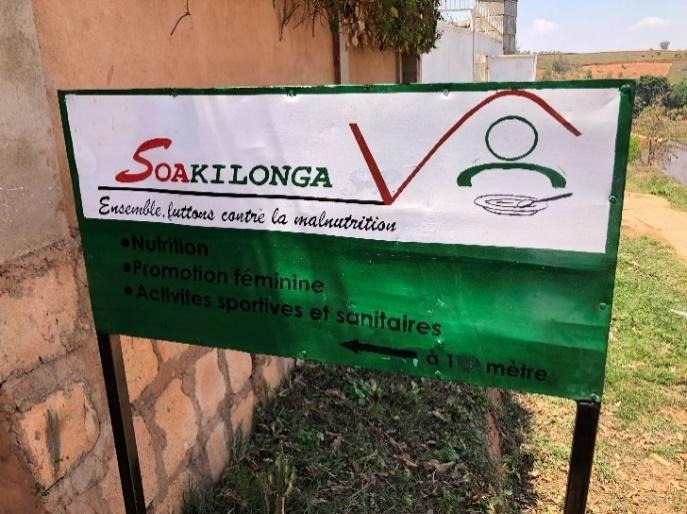
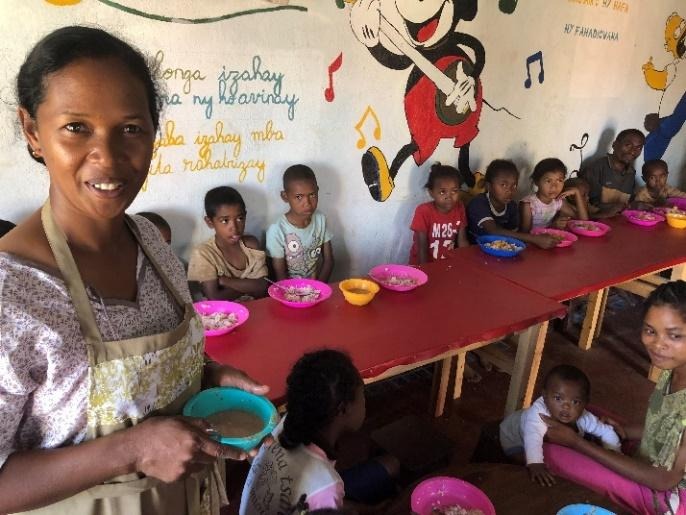
↑Soakilonga signboard School lunches using Natural Agriculture ingredients↑
○Centre de Compassion.(Compassion Madagascar):
An Orphanage run by Catholic sisters on the outskirts of the capital Antananarivo.
The practice of Natural Agriculture began in April 2023, with seven Sisters about 10 trainees managing the plots, and children participating in the work. They had been practicing organic farming using cow dung but were impressed by the flavor of the natural crops.